Future ultra-thin electronics may one day be built by stacking atomically thin materials like LEGO blocks, where simply changing the number of layers can control how the device behaves. Our work shows that adding thin layers of hexagonal boron nitride (hBN) on graphene changes how the two materials interact, which could help researchers design smaller, faster, and more energy-efficient electronic and sensing technologies.
To understand this, imagine placing soft blankets on top of each other. At first, the layers adjust and pull on one another, but after several layers they settle into a more comfortable arrangement. We found a similar effect in graphene and hBN: as more hBN layers are added, the structure relaxes, internal stress decreases, and the system becomes more stable — especially after about four layers. At the same time, tiny electric charges near the interface rearrange themselves, helping the layers adapt to each other.
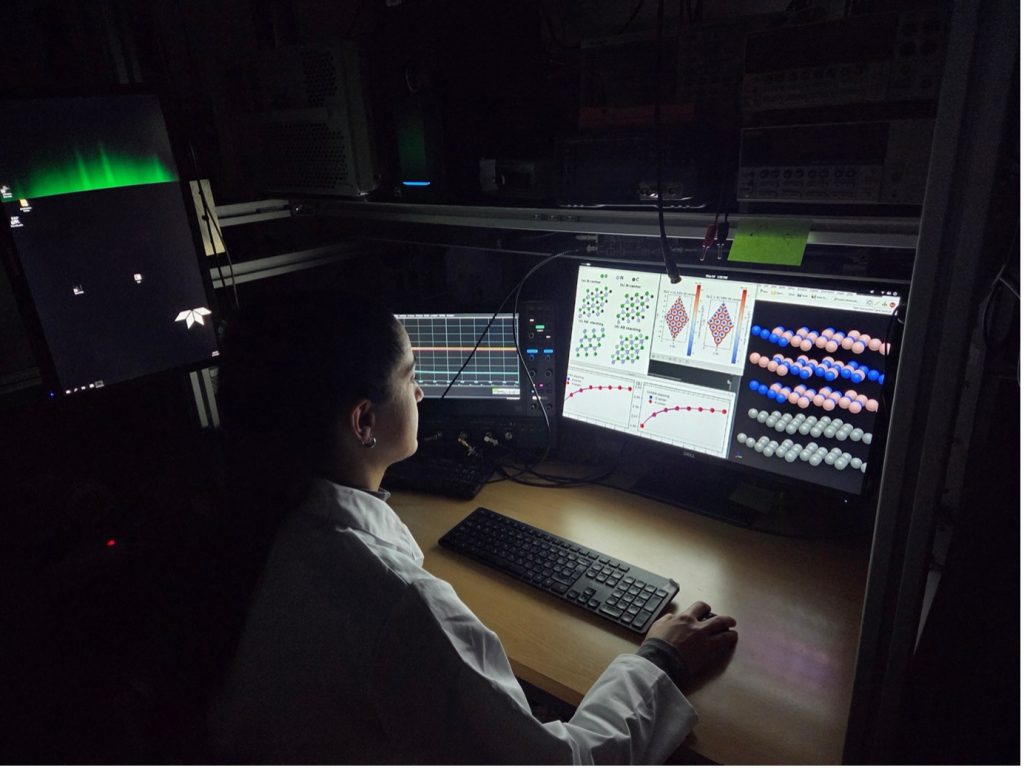
“Exploring quantum effects in two-dimensional heterostructures with computational simulations in is not a job, but a passion” says dr. Knarik Yeritsyan, a postdoc of the Laboratory of Organic Matter Physics.
Our researchers have performed a computational study of structural properties and charge distribution in graphene/BN heterostructures. The results were published here. The results of this work call for new experiments and ideas of exploitation.
This research was financial supported from the Slovenian Research and Innovation Agency (ARIS) under research core funding No. P1-0055 and project (Gravitacija, GC-0003). We acknowledge the HPC RIVR consortium and EuroHPC JU for funding this research by providing computing resources of the HPC system Vega at the Institute of Information Science, Slovenia under project No. S25O02-14.
Copyrights University of Nova Gorica. All Rights Reserved.