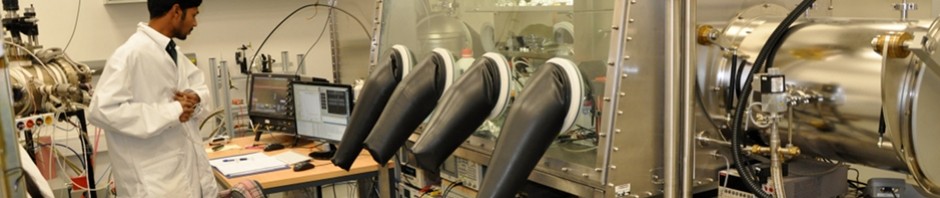
Our group has directly observed how excited electrons lose energy in thin films of Ti₃C₂Tₓ MXene, an important two-dimensional material with promising electronic and optoelectronic properties as was found in his previous study. The study was led by Jurij Urbančič, principal investigator.
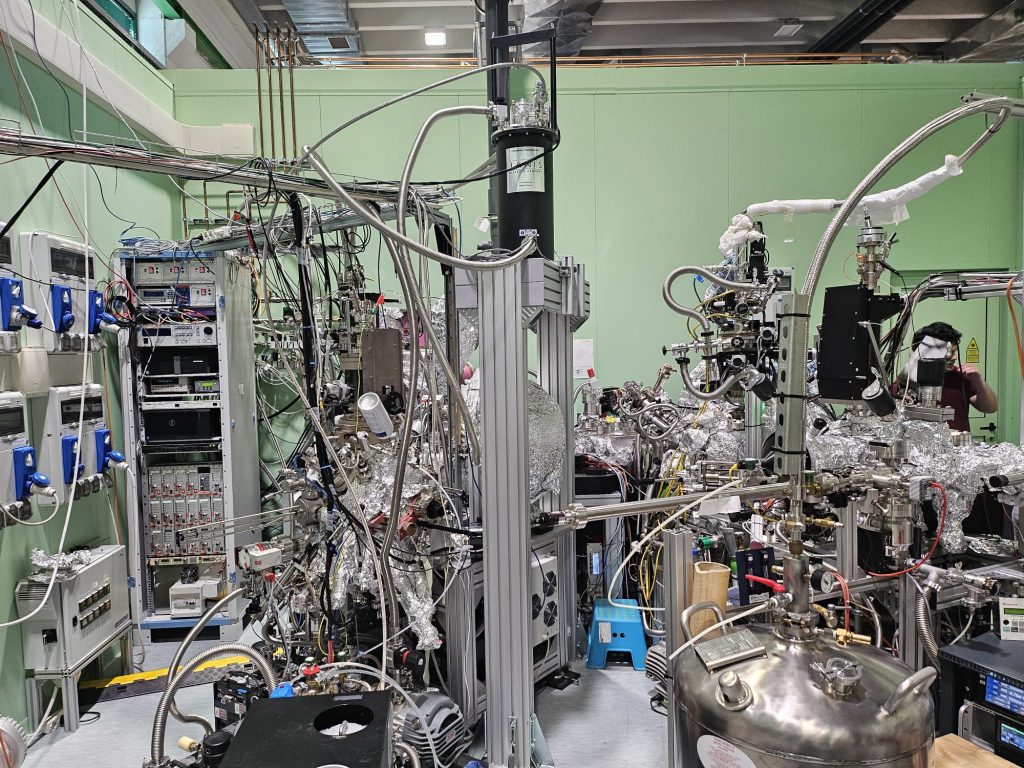
Laboratory of ultrafast time-resolved photoemission spectroscopy, where the study of fast electronic dynamics was performed. Photo: Jurij Urbančič.
Using ultrafast time-resolved photoemission spectroscopy, the team used one laser pulse to excite the material and a second extreme-ultraviolet pulse to take snapshots of the electrons only femtoseconds later. This allowed us to follow the motion of energy inside the material on its natural timescale.
The results show that electrons in Ti₃C₂Tₓ MXene cool extremely rapidly: after being excited, they relax in about 138 femtoseconds, less than one trillionth of a second. The electronic system briefly heats up by around 220 K before transferring its energy to the atomic lattice. This points to very efficient interaction between electrons and vibrations of the material, known as phonons.
These findings help explain how energy flows through MXenes immediately after light absorption. Such knowledge is important for designing future MXene-based electronic, photodetector, and optoelectronic devices, where fast charge and heat transport can strongly influence performance. The results were published here.
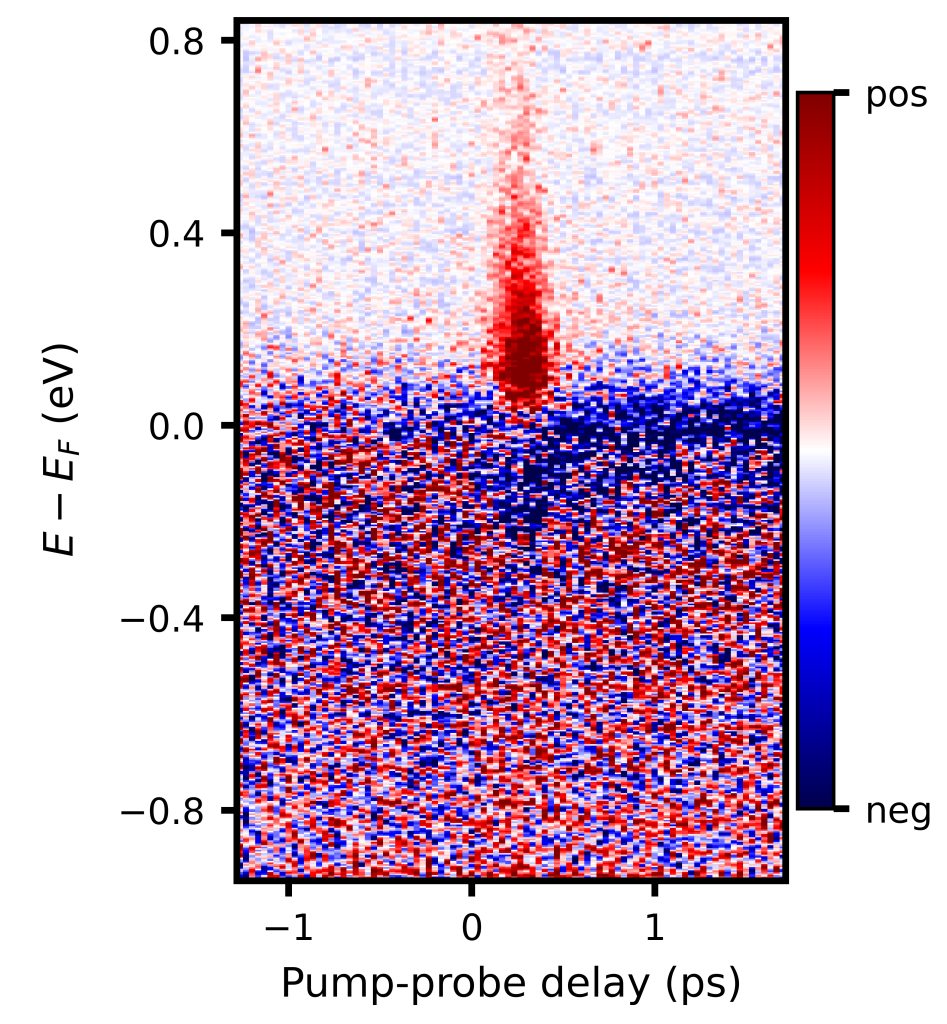
Figure: Time dependence map of electrons (red), which are at time zero on the bottom axis excited above the Fermi level. However, electrons transfer their energy and relax back down in just 138 femtoseconds. Author: Jurij Urbančič.
This research was financial supported from the Slovenian Research and Innovation Agency (ARIS) under research core funding No. P1-0055 and project (Gravitacija, GC-0003). This project has received funding from the European Union’s Horizon 2020 – Research and Innovation Framework Programme, under grant agreement No 101007417 NFFA Europe Pilot.
The group is also member of CC Chip.si, which promotes the semiconductors and semiconducting technologies. One of the pillars of the CC chip.si initiatives is to transfer knowledge to young talents. The knowledge acquired within this study represents a step forward in understanding ultrafast dynamics of photoexcited charge carriers in novel materials.
Copyrights University of Nova Gorica. All Rights Reserved.